- Aria's Browser History
- Posts
- How to think about "community" more intentionally
How to think about "community" more intentionally
Why your social media feed is lying about how "community" is the "new" big thing

Aria Ma
December 24, 2025
Hey there,
As the cadence of your inbox slows down and the never-ending small talk about your holiday plans come to a halt — I’d love to touch base with you about what I’m thinking about as we approach 2026 (gulps).
The one thing that continued to define 2025 at every corner I happened around, was “community.” The allure of finding your “people,” the happiness in finding someone who “gets” it.
The monetization of human “connection.”
My “community” includes people from across the economic spectrum — from the startup world to the human liberation movement. This concept of the monetization of community succumbs to a different taste for these different folks with vastly different world views.
On one hand, one group of people in my life believes that your work in organizing should be compensated. On the other hand, another group of people believes that it is part of the human imperative to support your community, for person and planet, to organize. That human connection is not to be monetized.
But what if we frame it in this way instead: real human connection, cannot be monetized.
From my browser to yours, Aria
⏰ TL;DR
Fundamentally, there is a power imbalance when one trades money in for an item. In order to build a real human connection, money may get you through the door (of the community), but it cannot replace the time you need to nurture that connection.
Real connection and community cannot be nurtured through a capitalistic lens.
Would you be interested in an accountability group for The Artist’s Way?
As someone who creates something, business, nonprofit, artwork, community, literally ANYTHING, you know better than anyone about the “block.” The strategy block, the creative block, the “amidoingtherightthing” block.
The Artist’s Way by Julia Cameron offers a 12-week program to help people reimagine their creativity by overcoming blocks like fear, self-sabotage, and limiting beliefs through an everyday practice. The book began as a project by Julia, to teach artists how to engage something so intangible and allow it to consume you. Eventually, it became a book and has been bought by more than 1 million people around the world. People will create these 12-week accountability groups to work together and nourish their inner child in whatever they are building.
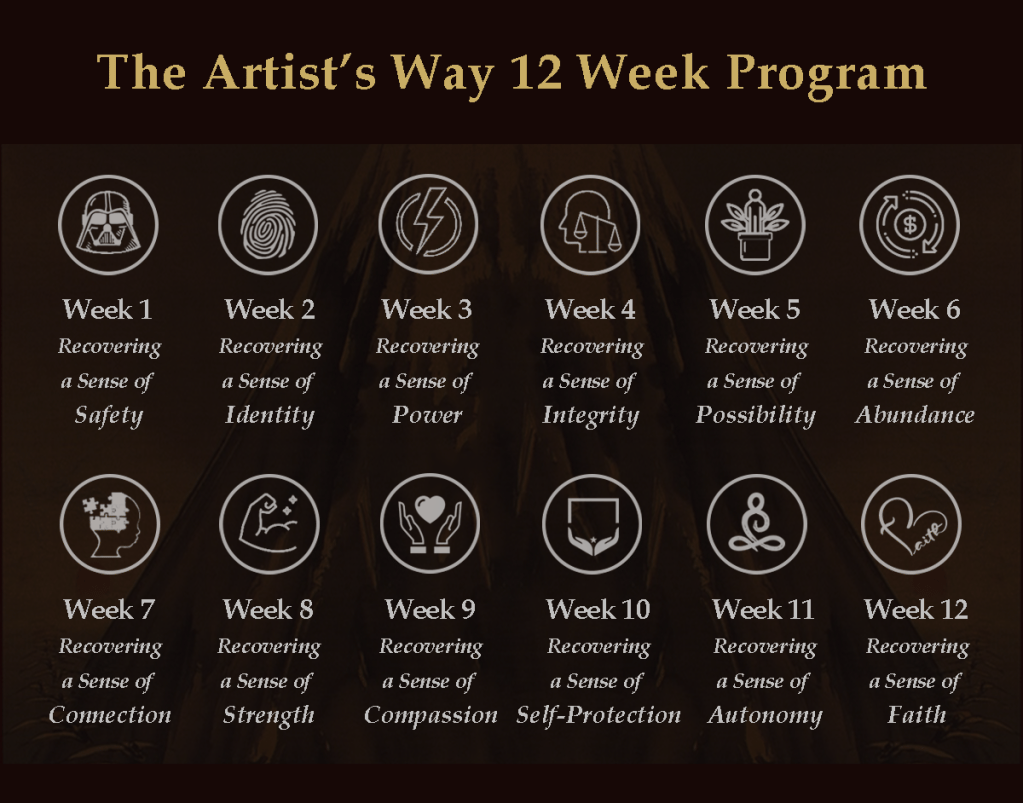
If this is something you’re interested in being apart of, feel free to reply to this email. I’m happy to organize something either in-person in the Somerville/Boston area, or remotely. Maybe this is your “new year’s resolution” agreement this year?
🔖 Bookmarks From Mine to Yours
Do you know how inflammation can change your behavior? My first, first-author paper has just been published. This piece fits into my wider repertoire on how inflammation of the body (or qi as its known as in Traditional Chinese Medicine), is a whole-body disruptor. But most notably, when introduced into the nervous system, has consequential effects on one’s behavior. You can read it for free here.
$8.8M in funding through pitch competitions, see the list here.
More than $2M in non-dilutive funds available to every founder, see the list here.
35th Annual Women in Business Conference at Harvard Business School just dropped their ticket link! Saturday, February 7th 2026. Check out the line-up and more information here.
Want recommendations to add to your reading list and stay on top of business & tech news? Here’s a list: 100 Top Voices in Business and Technology (sorry you’ll need to give Hubspot your email).
The classic “capitalism ruins everything” cliché
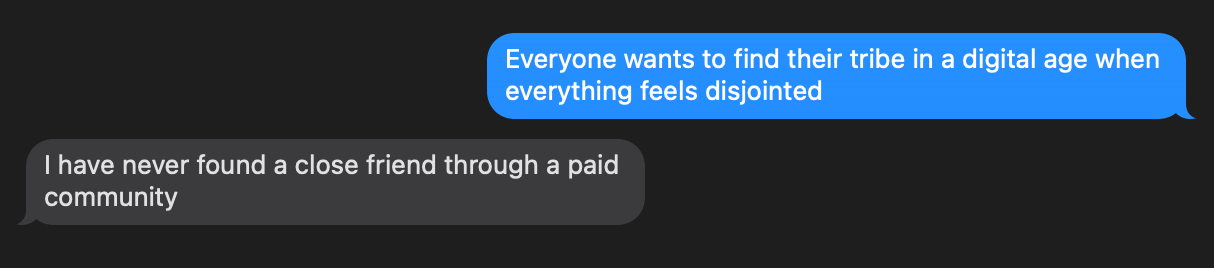
A recent conversation I had with a friend.
I’ve always been skeptical of joining paid communities. However, when I started learning about how these monetization schemes worked via HubSpot’s The Hustle and YouTube channels like Beginner Maps, it began to make sense to me.
My first year in college, was ALL online. This was during the part of the pandemic when we were all masked and never recognized anyone outside of a Zoom room.
Consequently, it made total sense to me that people were yearning for in-person connection after an unprecedented event. $29 a month to meet people who share my interest? Unlimited events, networking, and fun? Count me in!
However, the more I learned about how these communities operate, and how the operators are taught to operate — the more skeptical I grew.
There are a few communities I’ve glimpsed into where they are extremely successful. But not successful in a metrics, 200 people, $39 monthly membership, $7.8K MRR type of successful. These metrics are shallow.
The successful metrics look like:
Daily questions, chatter, and social messages sent from 50% of the members or more
Daily engagement from the moderators and the owner(s) of the community
Crowdsourcing resources, information, etc. before promoting anything
Engagement under community-driven questions (not just from the owners)
Consistent engagement month-month, not just the start and plunging as the membership grew
In a nutshell, actual conversation and relationship building defined a successful community. Around the niche of the community, and out of it.
I’ve had glimpses of communities where the people mean well, but it was not the one-stop-shop location where people are eager to build a relationship. It’s just another networking platform for them. Threads are filled with self-promo, and the owners sell accelerators, courses, e-books to the community. Soon, churn increases because, well, I was here to talk to other people, not get sold to with no one answering my questions.
You’re probably wondering, Aria, what kind of community drives engagement like the “successful” one you outlined?
One of my favorite organizations to point to cap their members at 500 people in the community. There is no yearly subscription, only monthly. They have dedicated the past year to grow their resources through “in-house hackathons” to create resources for the wider industry. They crowdsource and spend time together outside of talking about their industry. They feel comfortable asking for help on a whim. People are comfortable picking up the phone and typing in a reply when they get the notification. The founder don’t need to ask for testimonials, people in the community just GIVE them whenever. I’m not even in this community, and I recommend it to everyone I know who would find amazing value with them.
The startup world is “bullish” on IRL events when everyone else… never stopped doing them.
My friends who work in any part of the human liberation movement don’t have monthly memberships for their weekly meetups. Nor do they use Slack or Heart or Circle to have organizing threads for different interests.
Yet, they are the ones who I’ve observed to have the strongest, more rewarding relationships.
Relationships that go beyond the “what are you working on, how can I help?” conversations. The ones that go deeper past “are you doing anything fun over the holidays?”
Consequentially, their lives intertwine beyond the 9-5 work day. They’re deeply embedded in each other’s lives, both in a professional and personal sense. Their status quo is collective care, because we do not living as Innies or Outies.
Their versions of fireside chats and networking nights look like potlucks, collective art making, live music, and laughter. At the same time.
An analysis of “community” from a philosophical perspective
When money is introduced into an equation, a value is attributed to the object.
Our abstract understanding of money attributes this value to the benefit it may provide.
However, how do you place value on a human relationship?
Is your relationship with your mom worth a million dollars because she gave birth to you?
What about your partner who wears the hat of coach/therapist/accountant/assistant/pet sitter/etc? That’s at least a couple hundred dollars a month.
So, if I’m not paying that amount of money every month. Does that mean the relationship is not worth the value of the abstract monetary amount it’s attributed?
I’m sure there’s someone from MIT who’s created an equation.
When you remove money from the equation, the only attribute that matters in the relationship building process is time.
Time to invest in building a relationship. Time to show up to events and support your peers. Time to answer questions, ask questions, and engage in thoughtful conversations.
You give time, you get time.
So when we started paying X amount of money to join a community of people, that does not mean you also give X amount of time.
So engagement disappears, churn increases, and it only took you about $499 and a “wait, we’ll give you next month 50% off if you stay!” email that furthers this endless false dichotomy that money invested = time invested.
Money can’t buy you a community. Only time can.
Why this philosophical perspective is important for 2026
Unfortunately, this email won’t solve how capitalism functions in our society. Sorry I know I set high expectations.
I know, first hand, how DIFFICULT (teeth-pulling difficult) it is to host events with no funds. How hard it is to find locations to host the people you enjoy gathering with. How hard it is to convince potential sponsors and collaborators without the shallow metrics mentioned above. And perhaps this email isn’t an ode to fancy shmancy sponsored events, but rather, a reevaluation of the word “community.”
The world tells us that time is precious. But the world steals our time by personalizing our algorithms, telling us we can “save” time by using self-check out or buying UberEats, and this one’s my new favorite: use AI to save your time.
In each of these instances, we lose something. We lose our attention and control over impulsion from algorithms. We lose connection and understanding of nuance from the decrease in face-to-face with our fellow human. We lose and deteriorate our cognitive abilities from AI companies that aren’t even turning a profit with their LLMs.
What are you really comfortable with, in exchange for your time?
…
I honestly just sat here for about 5 minutes thinking, what kind of hard punch line, CTA can I put here to bring the newsletter full circle? But I don’t think I have a call to action besides to breath slower, reevaluate how you want to spend your time, and be intentional in the spaces you take up.
Social media has so much noise on what we “should” be doing. But I think we might find the answers in asking what we “ought” to be doing.
For a better life, better community, and better planet.
Happy holidays, and see you in 2026 (-:
📰 Random Recommendations
Are you watching Pluribus, Vince Gilligan’s (Creator of Breaking Bad and Better Call Saul) newest cult classic? Am I the 40th person who has asked you? It’s for good reason. Just watch the first episode. You won’t regret it.
A beautiful, deep-work vinyl mix set for the inevitable work you may be doing over the holidays.
Powering down, Aria ✌️