- Aria's Browser History
- Posts
- Future of Healthcare
Future of Healthcare
Diving deep into the industry of "preventative" healthcare and longevity

Aria Ma
January 20, 2026

Happy New Year!
(Are we still allowed to say that?)
We’re officially 10 days away from February. Quick vibe check, are you still adhering to your New Years’ goals?
In this month’s newsletter, I want to dive deeper into one of my more popular LinkedIn posts from last year regarding the changing landscape of accessible medical care.
What happens when you get two of the market’s most popular “preventative healthcare” services at odds with each other?
Disparaging ads, misinformation galore, and the never-ending hype of how AI will “replace” physicians, oh my!
Let’s take a look.
From my browser to yours, Aria
Vision Board Your 2026: Guided Workshop
How do you want to take control of your 2026?
The past few months, I've been reeling in so many tasks, sapping my energy. And I felt this need to do something with my hands. A pull to spark the creative in me.
What better than to be productive and creative at the same time?
This guided workshop at the beautiful Arts Collaborative Gallery in Medford will help you build a vision board to map out actionable steps to reach the goals you want to achieve this year. When I've done them before, I never knew when to start. But this workshop will provide prompts, food, and good company so you can just do the thing, instead of stressing over how to do the thing.
👉 Sign up for free here: https://luma.com/jkylxtcp

🔖 Bookmarks From Mine to Yours
Start-Up Grants/Accelerators
Start-Up World
20 minute reading on why therapy startups are growing, and why insurances don’t want to pay
ChatGPT is adding ads to their interface, what does this mean for consumerism?
How ClaudeCode can be your Executive Assistant
How AI chatbots and “executive agents” will sap product-market fit from the SaaS companies
Is this what “healthcare” has come to?
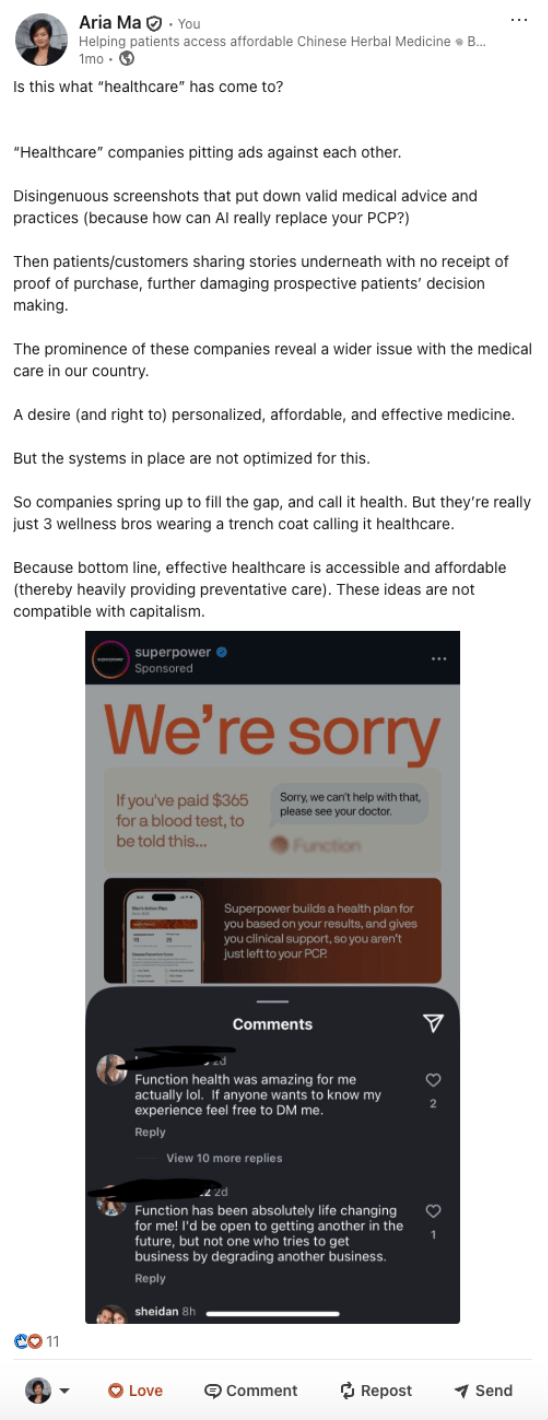
I made this post in December, and it was my most popular post all year, with more than 14,000 views and 10,000 unique member reaches.
When I had this ad come across my screen, my first instinct was annoyance. How are these (health)tech companies disparaging each other in paid advertisements?
Moreover, how are we at a point, where companies can purposefully disparage another company that refuses to use AI to give medical advice?
Let’s take a step back for a second.
Superpower is a company that gives customers the opportunity to test 100+ biomarkers through a blood test. They send your results and curated guidance on what to do to improve your health. Effectively, they advertise themselves as “preventative” care.
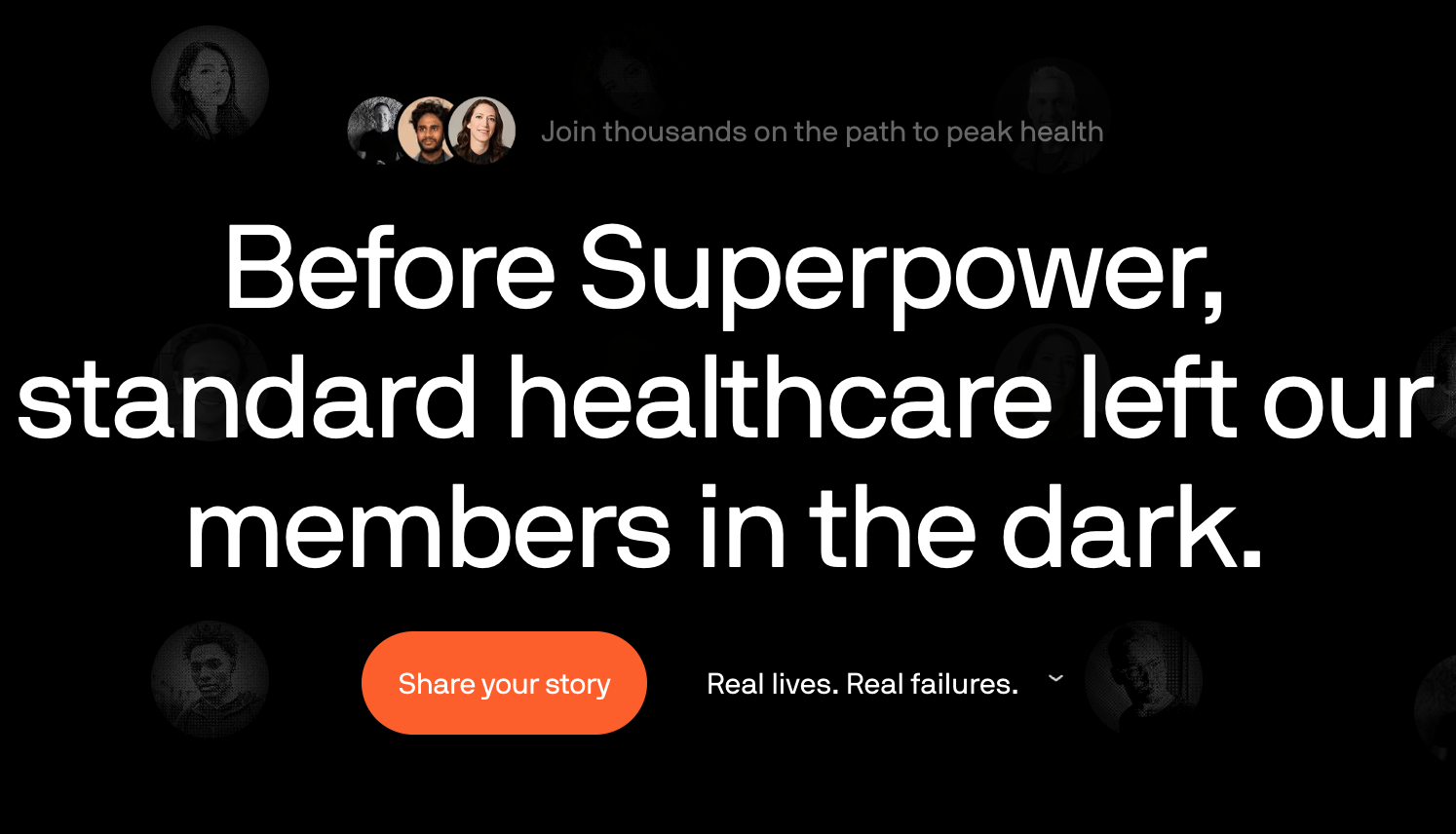
The premise of their marketing is filling the gap that our standard healthcare system has failed to resolve. That they provide affordable, preventative care by testing your biomarkers.
Meanwhile, Function does something very similarly by giving customers 1 blood test per year. However, they do 160+ biomarker tests and are about ~$100 more expensive. They’ve been around for about 2 years longer than Superpower.
Both use AI analysis to curate personalized health recommendations.
There are also reports of Superpower’s AI Concierge giving downright incorrect, and possibly fatal health advice (See Exhibit A).
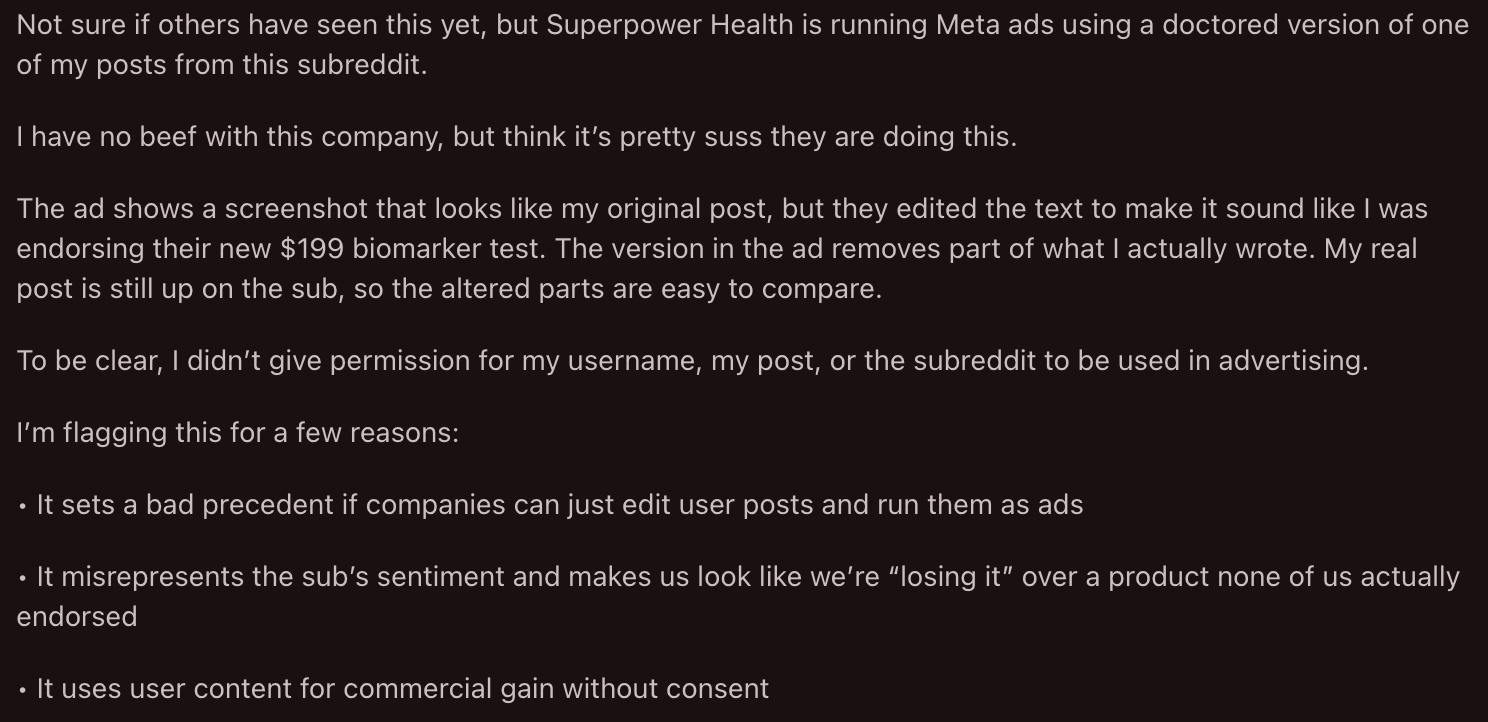
In line with their questioning marketing practices, they also doctored this Reddit user’s post and used it as an ad promoting Superpower.
Superpower secured a Series A funding round of $30 Million to create the world’s first health super app. Meanwhile, Function has raised $300 Million in their Series B round.
Interestingly, both companies have used popular buzzwords such as “longevity” and “preventative care” in their marketing and what their product provides. This new trend of “longevity” in my opinion is hurting healthcare more than it’s helping. Put succinctly by this Reddit user (tagged as an MD/PhD), NoFlyingMonkeys:
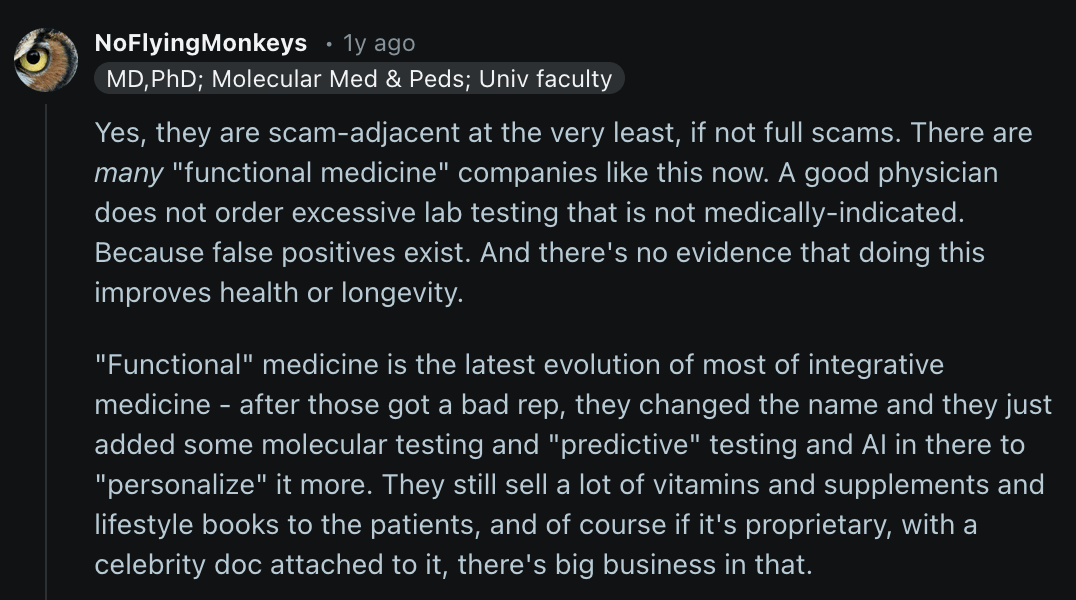
Regardless of the good and bad reviews of Superpower and Function, it cannot be understated how the rise of these healthtech companies are completely changing how medical professionals operate. Instead of just battling the “But I Google’d this and it said…” misinformation, now there are also unordered labs on the table they must keep in mind (while juggling patient paper work and patient care).
Closing Remarks
I’m disappointed in our healthcare system, and many others are too. That’s why they’re building healthtech companies like the above, and why I’m building jadewell. But the solution to the American Healthcare Conundrum is not startups raising millions of dollars to scale solutions antithetical to how physicians are taught to provide care. These types of companies only flourish in capitalistic systems, where people and corporations can take advantage of a broken system.
What about the single mom who works 3 part-time jobs to keep a roof over her family’s head? Or the older adult in their 60s still working because they don’t have retirement funds or access to Medicare? Where are the healthtech solutions for these folks? Do you think they have the privilege to care about preventative medicine or “longevity?”
Who are these healthtech companies really for?
Powering down, Aria ✌️